Home
After the Cover is Gone

Want me to read this post to you? Click the play button in the audio player below!
We noticed the mushroom almost all at once. On the walk home from the bus stop, it stood there as if waiting for us, firm, unbothered, independent. We knelt down to examine it.
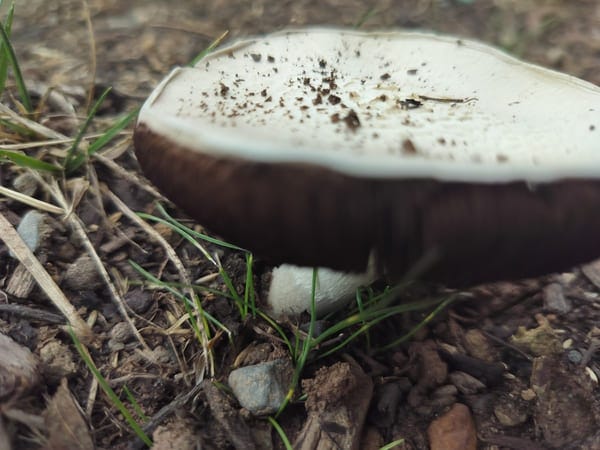
The afternoon had that soft gloom of a fairytale: overcast sky, muted colors, the world rendered in an enchanted filter. The mushroom looked like nature’s little pavilion. Its edges curled inward, like the lip of a bowl, less a random quirk of nature and more like a quiet act of care.
Its broad cap felt so theatrical that my son and I began imagining what might be underneath.
“What if we find a frog in pink slippers sipping tea and reading poetry to a beetle?” I said.
“I think it will be an ant camping with its friends,” he replied, without missing a beat.
We started naming the scene like we were branding a tiny woodland attraction:
Woodland Temple.
Raindrop Chapel.
Frogminster Grove.
I laughed at Frogminster Grove and made a mental note to search Etsy later for a figurine that matched the image in my head.
“Can we pull it out?” my younger son asked, as his older brother and I kept studying the mushroom.
“It looks comfortable here,” I said. “Let’s let it grow and see how big it gets.”
“Mr. Salazar is going to cut it down anyway,” he shot back, annoyed, but conceded.
Mr. Salazar mows our lawn every two weeks, weather permitting. Before Thanksgiving he put down grass seed (yes, I see the irony!) which likely gave rise to this single sprout. We let the mushroom be, at least for now.
Inside, backpacks were hung, some missing the hooks and landing face down like the dead man’s float you learn in swim class. I reminded the kids to wash their hands, their snacks already on the table. Someone asked if friends could come over; another informed me one was already enroute (apparently recess doubles as a playdate scheduler).
I love a house full of kids and friends, so I said yes and pulled out more plates.
Later that evening, once the house had quieted and the kids were drifting to sleep, I thought about the mushroom again. About how much we imagined beneath it: frogs, ants, rituals, teacups, community. About how we peeked underneath but didn’t lift it, as if lifting it might collapse a world we couldn’t put back. We let the mystery remain intact. We trusted that whatever was there deserved to stay hidden a while longer.
For a long time, this was how I moved through my life: trusting the shape of things. Believing that if something looked sturdy and stood even where it shouldn’t, then it must be sheltering something meaningful underneath.
That belief carried me through a marriage.
In 2021, an email arrived from a stranger. It said my husband of 13 years and the father of my four (very young) children had been having an affair for the last two years. I didn’t believe it at first. Maybe because believing it meant lifting something I wasn’t ready to look under. People like to call that denial. Some say it’s the result of being madly in love or too trusting. Others have called me naive for having the information right in front of me and not knowing how to use it. I suppose it was a combination of denial and survival. But what I learned soon after that first email arrived was that the call was coming from inside the house.
When I confronted him, he denied it calmly, firmly. He claimed he barely knew the woman named in the email. He said they were both getting anonymous messages accusing them of an affair. His phone had been hacked, he said. Everything sounded like an explanation you could hang your coat on — sturdy enough to keep you from looking for the cracks.
I asked if I should reach out to her.
“No,” he said. “If you give it attention, it’ll look like something is going on. All I have is my integrity.”
He spoke as if truth were a matter of tone.
What I didn’t understand then was that by waiting for him to either fess up (or file for divorce,) I was doing the work for him. By the time the truth became undeniable, by the time he married the woman named in that email without telling our children, without preparing them, without even introducing them (or me) to the new adult who would be spending time with my kids, the ground had already shifted.
The mushroom had been pulled up. And underneath it was only a hollow where meaning had been retroactively inserted by people who needed the story to sound cleaner than it was. It sounds foolish now, but the truth is, I didn’t know Muslim men that were capable of this level of deception. Not loudly, not recklessly, but bureaucratically. With plausible deniability. With mothers and sisters smoothing the edges. With entire families committed to the fiction that if something sounds principled enough, it must be.
In Desi Muslim culture (and I suspect this is true of many cultures shaped by patriarchy, hierarchy, and family mythology), women’s suffering is often served up as God’s wisdom. And no one tells you when you’re young, but there are only a few sanctioned ways for a woman to survive: You can be quiet, you can be agreeable, or you can be chalak — clever, strategic, fluent in the invisible rules.
If you’re exceptionally skilled, you can be all of these things; the overlap is larger than anyone is willing to admit.
But I…am none of those things.
I am too questioning to disappear without consequence and I cannot maneuver harm without it marking me.
In the last decade I have learned some hard lessons. There is a particular loneliness reserved for women who don’t fit neatly into “acceptable” categories. That kind of woman is often on her own long before she realizes it. And these ecosystems are not upheld my men alone. They are too often maintained, polished, defended, and rehearsed by women. Men’s behavior is translated into something more palatable while women are urged (and even told) to consider context, pressure, family expectations.
I was raised to believe intelligence meant discernment, not strategy. But in these spaces, being “smart” isn’t the same thing as being safe.
Education doesn’t protect you from being managed. Sometimes it makes you a bigger project. Women still shy of degrees/jobs/life experience are often sought out to be molded. Women with these privileges and advantages are often the ones families try hardest to tame.
I was intelligent enough to build a life, to raise children, to hold faith with care. But not savvy enough to recognize how often women are expected to absorb our own confusion as patience and loyalty while men’s deception gets softened into “mistakes,” “pressure,” “typical male behavior,” “fitna,” or, most insultingly, “dawah.”
Recently, my kids and I were playing a card game, Do You Really Know Your Family? and I pulled a card that told me to share a regret and the lesson it taught me.
It didn’t take long.
“I didn’t stand up for myself when I knew I was being treated badly at work or with family and I wish I had, ” I told them. “The lesson I learned was: no one is going to look out for you so you have to look out for yourself.”
They stared at me the way kids do when you say something that isn’t a lecture but also isn’t small. Like they were quietly filing it away for the future.
My children come back and forth carrying their stories, their confusion, their growing clarity, their humor, their love, their confessions. And over time, our home became less about who was missing and more about what was steady. Meaning returned not through grand revelations, but through noticing. Through walks home. Through imagined frogs and very real ants.
The grass seed took, the spores dispersed, the yard changed. The mushroom grew. I went outside to check the size of Frogminster Grove.
And it was gone.
Just like that it had vanished without warning. Not even a fingerprint of its existence remained.
Divorce can be deeply dysregulating. But it doesn’t always have to feel like devastation. Sometimes it feels like standing over a small cleared patch of earth, realizing what you mistook for shelter was only ever cover.
There’s a life lesson in that too. When something appeared sturdy, when it grew confidently where it shouldn’t have, or didn’t make sense to, I assumed it must be sheltering hopeful meaning underneath.
I knelt instead of pulling.
But some things don’t grow to protect what’s underneath, but simply to show us where we are willing to kneel and what we’re finally willing to name.